


Silver has fallen below $50 on rate fears and a stock sell-off, not on any change in its supply and demand, and the published forecast of a sixth straight shortfall still stands.
For much of this year, high inflation-adjusted Treasury yields, the return on safe bonds after inflation, have weighed on silver. The expectation was that silver would recover once those yields turned down. Since mid-October they have turned down, and silver has fallen faster. Yields fell mainly because a sell-off in technology shares sent investors into government bonds, not because the Fed eased. Fear of further Fed rate rises weighed on silver at the same time. That is bad news for the silver price over the coming weeks. Nothing in silver's supply and demand has changed, and the test that matters for the longer term comes at the Fed's December meeting.
Silver extended its fall on Friday. USAGOLD's report that day put silver at $49.09 an ounce, down 5.90% on the day. Gold was at $3,897.48, which puts the gold-silver ratio at 79.4. That ratio is the number of ounces of silver one ounce of gold buys. USAGOLD had silver at $60.53 on October 13. It has fallen 18.9% since.
The Federal Reserve held interest rates on Wednesday, and two of its members voted for a rise. The next day, official figures showed the economy growing at an annual rate of 3.4% in the third quarter. PCE inflation, the Fed's preferred gauge, ran at 3.6% a year, which kept a December rise in play. This is the pattern I have tracked for Golden Meadow® readers since March: inflation news moves silver through what it means for the Fed.
There are five Deep Dives in this issue of the premium Silver Catalyst newsletter, and in this article, I'll focus on one of them.
Why Lower Yields Should Help Silver
Silver pays no interest. When safe government bonds pay a high return after inflation, holding silver means giving that return up. When that return falls, the cost of holding silver falls too. In Silver Rising, I argue that this explains most of silver's moves from one year to the next.
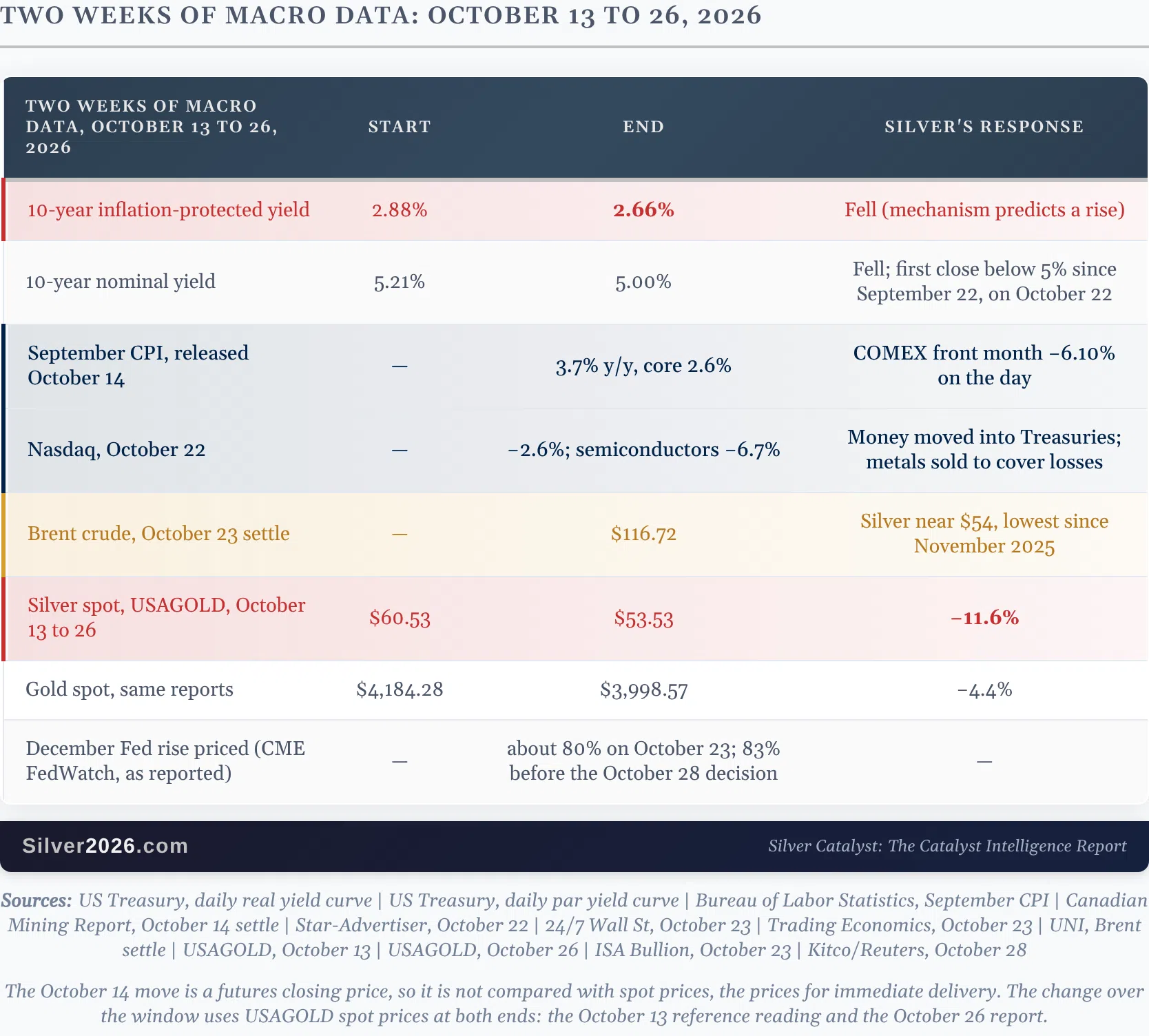
The last two issues of the newsletter expected that lever to turn in silver's favour once those yields fell. Over the two weeks the latest issue covered, the 10-year inflation-protected Treasury yield fell to 2.66%. That was a drop of 22 basis points, each one a hundredth of a percentage point. Silver fell 11.6% over the same stretch. By October 29 the yield had slipped further, to 2.63%.
Why Yields Fell, and Why Silver Fell Faster
The explanation lies in why yields fell, and easier Fed policy was not the reason. About half the fall came gradually in the first week, and the data do not point to a single cause for it. The other half came in one day, on October 22.
Fears about spending on artificial intelligence sent the technology-heavy Nasdaq index down 2.6% and chip-making shares down 6.7%. Investors moved money into Treasuries, which pushed yields down. Traders also sold precious metals to cover losses elsewhere, Trading Economics reported. A scare about growth tends to hit silver harder than gold, because most silver is bought by industry. Metals Focus and the Silver Institute forecast industrial demand at more than half of all silver demand this year.
The inflation side worked against silver too. September consumer prices rose 3.7% from a year earlier, which raised the odds of another Fed rise. Silver futures, contracts for later delivery, fell 6.1% on October 14, the day of the report. Then strikes by Yemen's Houthi rebels on Saudi targets pushed oil to its highest close in nearly six months. Silver fell to around $54, at the time its lowest since November 2025.
Gold held up better. It fell 4.4% over the two weeks, against silver's 11.6%. The table sets out each step.
Sources: US Treasury, daily real yield curve | US Treasury, daily par yield curve | Bureau of Labor Statistics, September CPI | Canadian Mining Report, October 14 settle | Star-Advertiser, October 22 | 24/7 Wall St, October 23 | Trading Economics, October 23 | UNI, Brent settle | USAGOLD, October 13 | USAGOLD, October 26 | ISA Bullion, October 23 | Kitco/Reuters, October 28
The October 14 move is a futures closing price, so it is not compared with spot prices, the prices for immediate delivery. The change over the window uses USAGOLD spot prices at both ends: the October 13 reference reading and the October 26 report.
What the Fed Did, and What Comes Next
So the expectation needs a condition attached. Falling real, or inflation-adjusted, yields help silver when they come from easier Fed policy. They hurt it when they come from a growth scare. In that case, industrial buyers react to weaker growth before investors react to lower yields. I drew that line after seeing the result, so it is a hypothesis to test, not proof.
The Fed's decision on October 28 did not test it. The Fed held rates, two members wanted a rise, and the statement gave no guidance on December. Markets still put the chance of a December rise at about 83%, Kitco reported after the decision.
Friday's sell-off followed a similar pattern, with bets on a December rise also weighing. A fall in technology shares sent money into bonds. Treasury yields and the dollar both eased, USAGOLD reported, yet silver still fell close to 6%.
The real test comes at the December meeting. Suppose markets stop expecting a rise, and real yields fall for that reason. If silver still lags gold then, the book's real-rate argument would need to be qualified.
What This Means to Silver Investors
Over the coming weeks, this pattern is bad news for the silver price. While inflation keeps a Fed rise in play, energy shocks and stock-market scares have pushed silver down rather than up. That can continue.
For a longer-term holder, the news is narrower than the price suggests. No supply or demand figure changed in these two weeks. What failed was the link between yields and the silver price, and it failed for a reason that can reverse. Metals Focus and the Silver Institute still forecast a shortfall of 46.3 million ounces for 2026, which would be the sixth in a row. Metals Focus, which compiles the World Silver Survey for the Silver Institute, has said in an interview that it now expects a smaller one. Their interim review, expected in mid-November, will show whether the published figure changes.
The book's real-rate argument is about moves from one year to the next, so two weeks can qualify it but not settle it. The signal to watch comes in December. If markets drop their expectation of a rise and silver then does better than gold, that would suggest the lever is working in silver's favour again. You can follow how silver has traded in 2026 and the longer-term case as that test approaches.
How interest rates move the silver price is one dimension of the 100-catalyst framework I analyze in Silver Rising, alongside the four other Deep Dives in this issue of the Silver Catalyst newsletter. If you've at least considered investing in silver, I strongly encourage you to sign up, because it takes just $1 to get both. Get full Silver Catalyst Newsletter and Silver Rising book for $1 today.
Thank you.
The Silver Engineer