


Silver has slipped below $45 an ounce, yet the big vaults in London and New York have not been filling up, which means the fall is not coming from a surplus of metal, and the supply case for owning silver still stands.
If silver were piling up unsold, the big warehouses would usually show it. They do not. London held less silver at the end of October than a month earlier, the first fall in six months. In New York, the metal ready for delivery against futures barely moved while the price dropped. And India, the world's biggest silver consumer, spent nearly three times as much on silver imports in October as in September. On the stockpiles alone, that is a small positive for silver holders, based on one month of data. It is not a sign of a squeeze, and the next test starts on November 30.
Silver traded near $44.93 an ounce late on November 18. It was down about 5% on the day. Hawkish minutes from the Federal Reserve's last meeting added to bets on a December rate rise. The gold-silver ratio stood near 83, meaning one ounce of gold buys about 83 ounces of silver. Silver is now about 37% below its 2025 close. The latest premium issue at Golden Meadow® found the inventory picture calmer than the price.
There are six Deep Dives in this issue of the premium Silver Catalyst newsletter, and in this article, I'll focus on one of them.
London: The First Fall in Six Months
London is the centre of the world's wholesale silver trade, where large bars are stored. At the end of October its vaults held 28,889 tonnes, about 928.8 million ounces (Moz), according to the LBMA's monthly data. That is about 3.1 Moz less than at the end of September, after five monthly rises in a row.
A fall in London's stock is a change in where silver sits, not a measure of silver used up. Some of it may have gone to India, some to exchange-traded funds, which hold silver for investors and trade like shares, and some elsewhere. The LBMA does not say.
The vaults are well stocked but not full. They hold about 21% less than at their June 2021 peak. Metals Focus, a research firm, put the metal available outside those funds at about 267 Moz. Kitco reported the estimate alongside end-September vault data. That is nearly double the 136 Moz of London stock outside funds at the end of September 2025. Metals Focus and the Silver Institute called that a "record (reported) low", and it came weeks before London's October squeeze, when buyers struggled to find metal there. The two figures come from different reports and may not cover exactly the same metal. The 267 Moz figure also predates October's data, so the two cannot be combined to work out a new balance.
Funds may also have drawn on that metal. The iShares Silver Trust, which keeps most of its metal in London, added about 11 Moz from the end of September to November 10. If that metal came out of London's stock, the silver not held by funds fell by more than London's reported total did. That is my inference, because the LBMA does not split its figures by owner.
New York: Steady Through the Sell-Off
COMEX is the main US futures exchange, where traders agree a price today for silver delivered later. Its "registered" silver is metal with a warrant, a receipt that makes it ready for delivery. Registered stock stood at 101.63 Moz on November 9, on the exchange's own report. On November 18 it was about 101.2 Moz, on CME Group figures compiled by MetalCharts. The price fell hard over those nine days, and the deliverable metal hardly changed.
Open interest is the number of futures contracts still open. Counted in ounces, it came to about 5.7 for each registered ounce, the same ratio as a week earlier. Money managers, mostly hedge funds, held net bullish bets of 3,615 contracts on November 10. That is their bets on a rise minus their bets on a fall, and it is close to their lowest since February 2024.
So far fewer of these traders are betting on a rise than earlier in the year. The figure does not show how much forced selling is left, though. Large bets in both directions sit inside that small net number and cancel each other out.
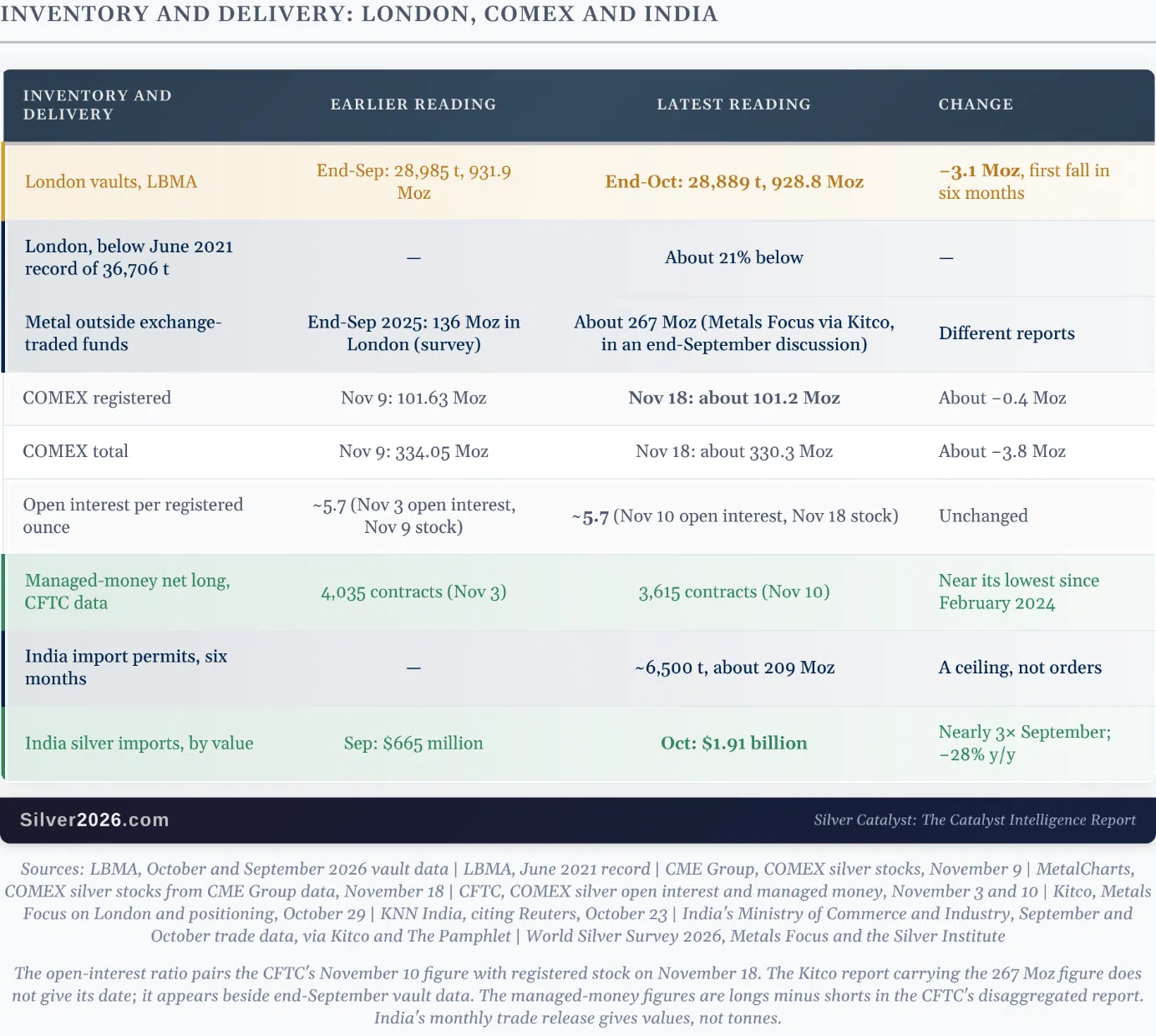
Sources: LBMA, October and September 2026 vault data | LBMA, June 2021 record | CME Group, COMEX silver stocks, November 9 | MetalCharts, COMEX silver stocks from CME Group data, November 18 | CFTC, COMEX silver open interest and managed money, November 3 and 10 | Kitco, Metals Focus on London and positioning, October 29 | KNN India, citing Reuters, October 23 | India's Ministry of Commerce and Industry, September and October trade data, via Kitco and The Pamphlet | World Silver Survey 2026, Metals Focus and the Silver Institute
The open-interest ratio pairs the CFTC's November 10 figure with registered stock on November 18. The Kitco report carrying the 267 Moz figure does not give its date; it appears beside end-September vault data. The managed-money figures are longs minus shorts in the CFTC's disaggregated report. India's monthly trade release gives values, not tonnes.
India: The Buyer Came Back
India is the world's biggest silver consumer and imports most of what it uses. Dealers told Reuters that in late October the government issued permits to import about 6,500 tonnes over six months. That is about 209 Moz. It comes to roughly nine-tenths of India's imports in all of 2025, which Metals Focus and the Silver Institute put at 232.2 Moz.
A permit is a ceiling, not an order. When the permits were issued, Indian buyers were paying only 45 cents an ounce over official domestic prices. That points to a market that was not short of metal that week.
The first trade figures since then are firmer. India's commerce ministry put October silver imports at $1.91 billion. That is nearly three times September's figure. These are values, not volumes, and the price moved between the two months. October was still about 28% below October 2025, when India was buying heavily during the squeeze in London. November's figures, due in mid-December, will be the first full month under the new permits.
What This Means to Silver Investors
The stockpiles tell a different story from the price. A price that falls because there is too much silver around tends to leave metal sitting in vaults. In October, London's stock fell and India's imports rose. Into mid-November, New York's deliverable stock held. On one month of data, that is a small positive for the case that the world uses more silver than it produces.
It is not evidence of a shortage you can see yet. London is well stocked, nothing in New York showed strain, and India's buying came after months of curbs. Market reports blame the price fall largely on expectations of a December rate rise and a firmer dollar.
In their interim review on November 12, Metals Focus and the Silver Institute still forecast a sixth annual shortfall in a row, of about 35 Moz. That is smaller than the 46.3 Moz they expected in April. They also said that fund selling and the smaller shortfall have helped ease tightness this year in the physical market, where bars and coins change hands.
The next tests come quickly. November 30 is the first day buyers holding December contracts can be told their metal is ready for delivery. December is one of COMEX's main delivery months. A smooth month with registered stock near 100 Moz would confirm the calm. The LBMA's November figures follow around December 7, and India's November imports in mid-December. Stockpiles are one of the forces I follow in Silver Rising, and I keep track of how silver has traded against them.
Silver stockpiles are one dimension of the 100-catalyst framework I analyze in Silver Rising, alongside the five other Deep Dives in this issue of the Silver Catalyst newsletter. If you've at least considered investing in silver, I strongly encourage you to sign up, because it takes just $1 to get both. Get full Silver Catalyst Newsletter and Silver Rising book for $1 today.
Thank you.
The Silver Engineer