


Peru and Mexico both mined less silver than a year earlier, and Mexico was the one expected to grow, so the supply case that silver holders rely on just got a little firmer.
Metals Focus and the Silver Institute forecast world mine supply to slip slightly this year. They expect gains in Mexico and Morocco to be more than offset by declines, mainly in Peru and Argentina. Peru is falling as forecast. Mexico's latest monthly figure, for July, went the other way. Then on October 8 a strike was formally declared at San Dimas, one of Mexico's larger silver mines, where work had already stopped. One month does not overturn a full-year forecast, and the ounces involved are small next to this year's expected shortfall. But the direction favours silver holders over the coming year, even while interest rates drive the price in the short run.
The price has not reflected any of this yet. Silver fell about 6% on October 14. US consumer prices had risen faster than expected, and markets moved toward another Federal Reserve rate rise. Kitco's late-afternoon reading put silver at $55.41 and gold at $4,098.80. That is a gold-silver ratio of about 74. At that reading silver was about 22.7% below its 2025 closing price, on MetalCharts' figures. Silver pays no interest, so it becomes less attractive to hold when bonds pay more after inflation. Real yields, the return on bonds after inflation, and the dollar have been the main near-term influences on the price this year, though the daily link is not one-to-one. At Golden Meadow® I track both sides: the price, which answers to rates in the short run, and the balance of supply and demand, which builds the longer-term case.
There are six Deep Dives in this issue of the premium Silver Catalyst newsletter, and in this article, I'll focus on one of them.
A Strike at One of Mexico's Larger Silver Mines
Workers at First Majestic's San Dimas mine in Durango stopped work on September 18. On October 8 about 800 of them, in two sections of Mexico's national miners' union, made it a formal strike. Extraction of gold and silver is halted. The union cites safety conditions, worn equipment, breaches of the labour contract and a productivity bonus. As of October 13, local reports said work remained completely halted, with no agreement and no date set for a return.
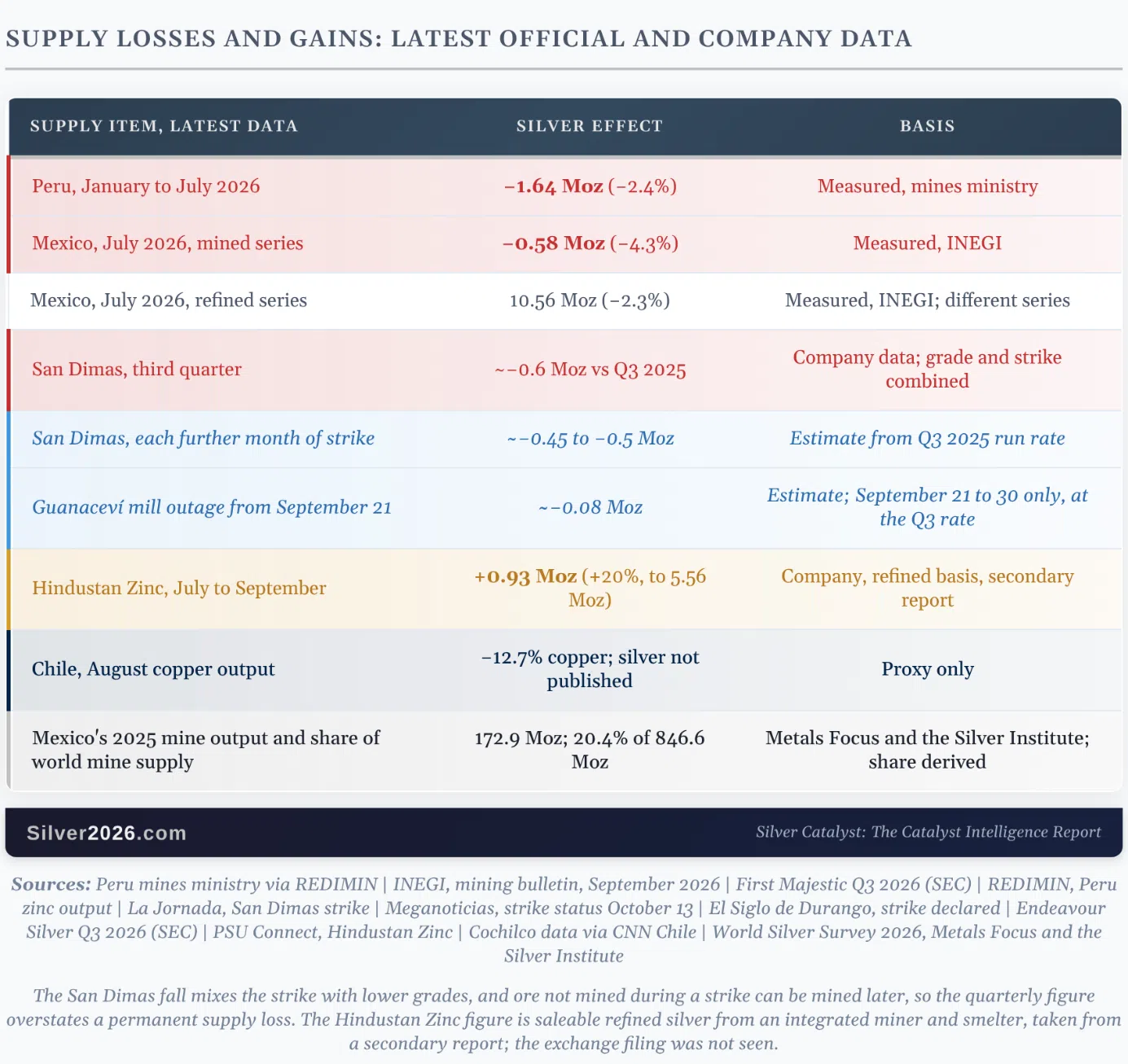
The dispute was already showing in the company's numbers. San Dimas produced 41% less silver in the third quarter than a year earlier, according to First Majestic's own release. The company blames 12 operating days lost to the dispute. It also cites lower grades, meaning less silver in each tonne of ore, which it links to the dispute as well. At last year's pace of output, each further month of strike removes roughly half a million ounces.
That quarterly fall needs reading with care. It mixes the strike with lower grades. Ore that is not mined during a strike can be mined later, so the quarter overstates any permanent loss of supply.
Peru and Mexico Both Mined Less
In August, I looked at what cut silver output in Mexico, Peru and Chile at once. The latest official figures point the same way, and they measure silver directly rather than estimate it.
Peru's mines ministry reported less silver for January to July than in the same months of 2025. The fall was 1.64 million ounces, or 2.4%. Silver output in July on its own rose 0.5%, so the decline came earlier in the year. Much of Peru's silver comes out of zinc and lead ore, and Peru's zinc output fell 22.2% in July. That fits the survey, which expected Peru's decline to come from lower output at its lead and zinc mines.
In Mexico, the statistics agency INEGI put July's mined silver 4.3% below a year earlier. That is a loss of about 0.58 million ounces in one month. Mexico also publishes a series for refined silver, which fell 2.3%. The mined series is the one that measures what came out of the ground.
Chile adds a copper signal, which is not the same as a silver signal. Copper mines are the second-largest source of byproduct silver, the silver recovered as a side product of mining another metal. Chile's copper output fell 12.7% in August, and workers at the Centinela copper mine went on strike on October 7. No Chilean source publishes the silver in that copper, so it is a pointer rather than a measurement.
Sources: Peru mines ministry via REDIMIN | INEGI, mining bulletin, September 2026 | First Majestic Q3 2026 (SEC) | REDIMIN, Peru zinc output | La Jornada, San Dimas strike | Meganoticias, strike status October 13 | El Siglo de Durango, strike declared | Endeavour Silver Q3 2026 (SEC) | PSU Connect, Hindustan Zinc | Cochilco data via CNN Chile | World Silver Survey 2026, Metals Focus and the Silver Institute
The San Dimas fall mixes the strike with lower grades, and ore not mined during a strike can be mined later, so the quarterly figure overstates a permanent supply loss. The Hindustan Zinc figure is saleable refined silver from an integrated miner and smelter, taken from a secondary report; the exchange filing was not seen.
What Pulls the Other Way
Supply is rising in some places, and an honest reading has to count them. India's Hindustan Zinc reported 20% more refined silver in the July to September quarter, about 0.93 million ounces. That is saleable metal from a company that both mines and smelts, taken from a secondary report. It measures something different from Mexico's mined output, so it cannot be subtracted from Mexico's decline. It does show supply growing elsewhere.
In Mexico itself, Endeavour Silver's total silver output across its mines rose 19% as its new Terronera mine ramped up. Discovery Silver's Cordero project in Chihuahua received its federal environmental permits on October 6. The bank BMO's model puts first production in the second half of 2029, so it adds no supply for years.
What This Means to Silver Investors
Silver that is used has to come from somewhere: a mine, recycling or a stockpile. When mines and recyclers supply less than the world uses, stockpiles fill the gap. Metals Focus and the Silver Institute forecast that gap at 46.3 million ounces this year, which would make 2026 the sixth year in a row of shortfall. Other things being equal, less silver mined in Peru, Mexico or at San Dimas widens it.
The size is modest. The measured declines in Peru and Mexico add up to about 2.2 million ounces. They cover different periods, so this is not a global estimate. A strike that lasts through November would add about another million ounces. None of it is large next to the forecast shortfall.
The direction matters more than the size. The survey expected Mexico to grow this year and soften Peru's decline. July went the other way, and one of the country's larger silver mines is now shut. A single month does not overturn a full-year forecast. Mexico's August figures, due around October 21, will show whether July was a blip or the start of a run. Third-quarter results from the larger producers follow from late October.
So this is good news for silver holders on the supply side, at a small scale, and it matters over the coming year rather than the coming week. The price fell on interest rates this week and may keep answering to them for a while. The supply side is what builds the longer-term case, and in the latest data it got firmer.
Silver supply in Peru and Mexico is one dimension of the 100-catalyst framework I analyze in Silver Rising, alongside the five other Deep Dives in this issue of the Silver Catalyst newsletter. If you've at least considered investing in silver, I strongly encourage you to sign up, because it takes just $1 to get both. Get full Silver Catalyst Newsletter and Silver Rising book for $1 today.
Thank you.
The Silver Engineer