


The Treasury bought $5.2 billion of its own long bonds and could not stop yields rising; a week later the Federal Reserve raised rates and could not stop silver rising, and one rule explains both.
The rule, as I read it, is that silver in 2026 follows long-term interest rates and the oil price that feeds them, not the size of the deficit. When long yields rise, silver falls, whatever the Treasury does to stop them. When long yields fall, silver rises, even in the week the Fed tightens. That is good for silver whenever yields ease, and the past week showed the metal responds within days. It is bad for the idea that a large deficit lifts silver on its own. The deficit got worse in September and silver fell; then yields eased and silver recovered. The verdict holds until early November, when the Treasury's current run of enlarged buybacks ends and the mechanism gets its next full test.
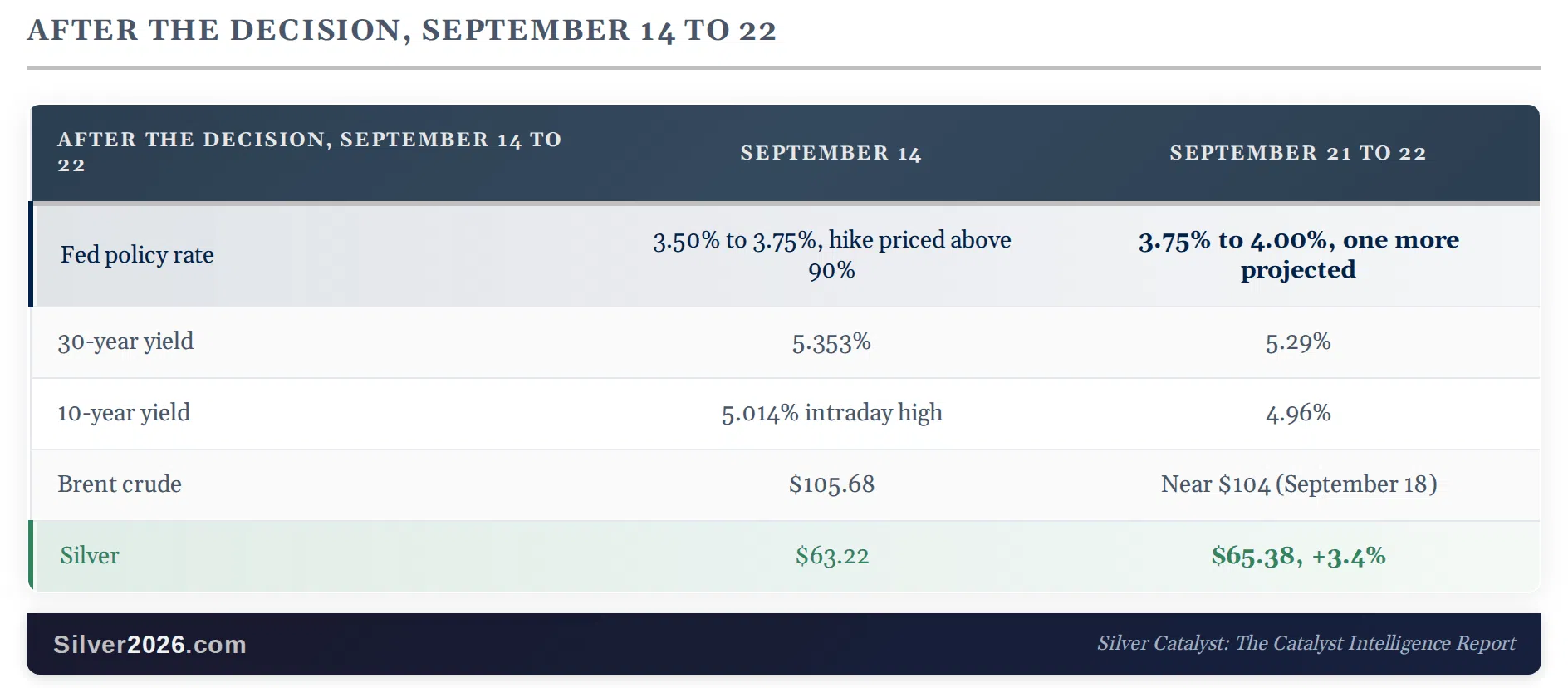
Silver traded at $65.38 an ounce early on September 22 against gold at $4,322.95, a gold-silver ratio of 66.1. That is 4.5% above where it stood on the evening of September 16, the day the Federal Reserve raised its policy rate. The increase was a quarter point, to 3.75% to 4.00%, and the Fed's projections showed a median of one more this year. Silver is about 8% below where it started 2026. It is roughly 46% below its January peak of $121.58. The move since the decision came as the 10-year Treasury yield slipped back under 5% and oil eased. Brent went from above $105 toward $104 on reports that Saudi Arabia was working to restore its East-West pipeline. The Golden Meadow® research this article draws on has tracked the link between silver and the bond market through three issues now. September tested it twice in two weeks.
There are six Deep Dives in this issue of the premium Silver Catalyst newsletter, and in this article, I'll focus on one of them.
The Treasury bought $5.2 billion of long bonds on September 10, and long-term yields rose anyway
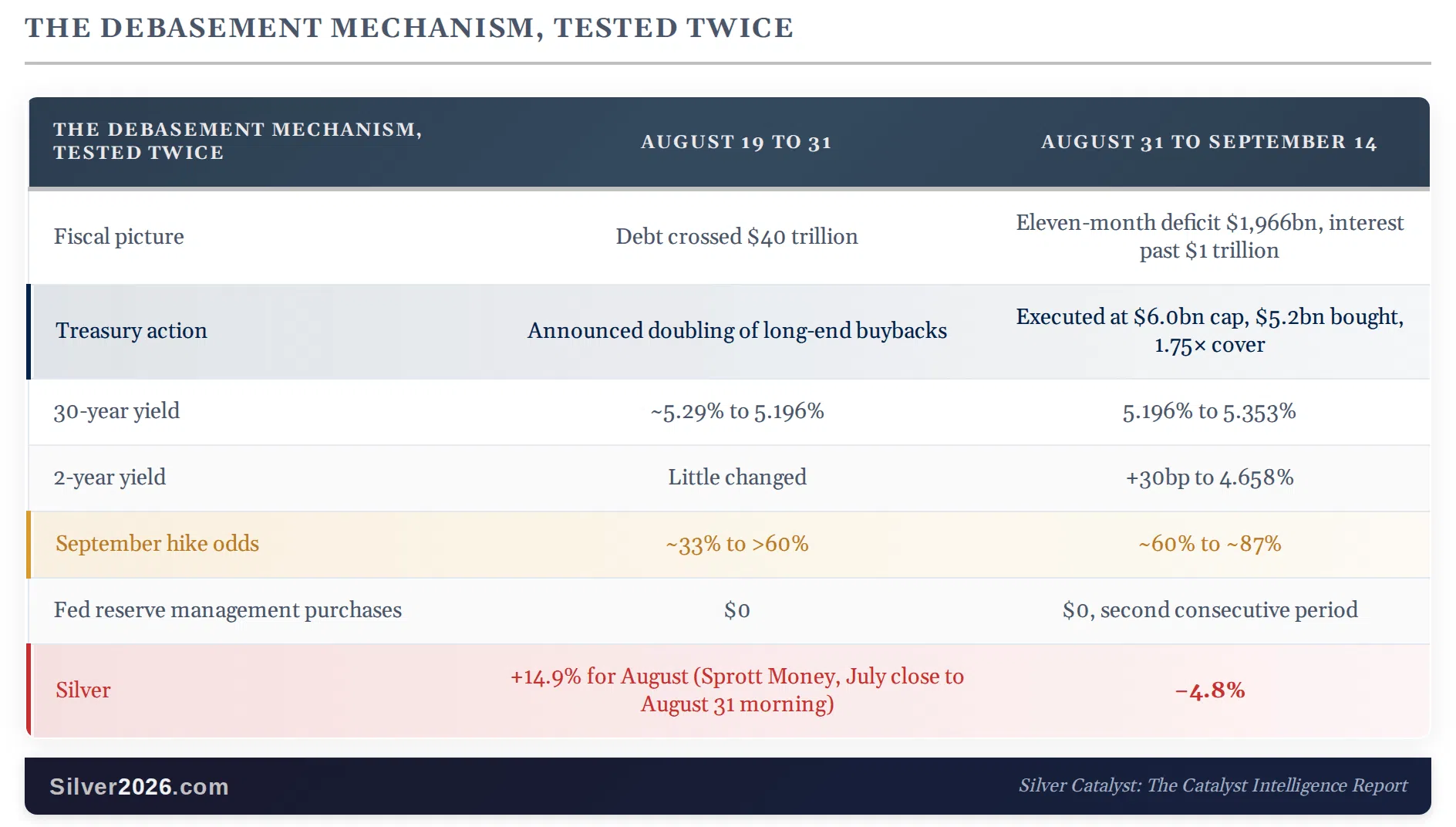
The previous issue closed with a hypothesis. Silver, it said, may respond to how officials react to fiscal stress rather than to the stress itself. The idea was simple. When the Treasury or the Fed steps in to hold borrowing costs down, investors read that as money being printed to cover the deficit. Silver rises as protection. August looked like proof. On August 19 the Treasury announced it would at least double the size of its buybacks of long-dated bonds. In a buyback the Treasury buys its own debt back from the dealers who hold it. The 30-year yield fell, and silver rose 14.9% in the month on Sprott Money's series, from the July close to an August 31 morning reading.
The first test of the hypothesis arrived on September 10, and the hypothesis needed a condition. The Treasury ran the first of the enlarged operations, buying bonds that mature in 10 to 20 years. The cap was $6.0 billion, above the minimum it had announced. It bought $5.2 billion. The operation was larger than promised and on schedule. Long-term yields still rose. The 30-year yield had fallen to 5.196% on the day of the announcement. By September 14 it stood at 5.353%. The 10-year touched 5% for the first time since 2023. Silver fell 4.8% over the two weeks.
The fiscal picture had not improved in the meantime. It had got worse. The August Monthly Treasury Statement put the deficit at $1,966 billion for the first eleven months of the fiscal year. Interest on the debt passed $1 trillion for the first time. What changed was the inflation data and the oil price. A strong jobs report arrived on September 4. A week later, core inflation, which strips out food and energy, came in hotter than expected. Together they took a September rate rise from a coin flip to a near certainty. The 2-year yield, the one that tracks what the Fed will do next, rose about 30 basis points. Brent crude went from around $95 to above $105 when Saudi Arabia shut its main export pipeline. The Fed reads dearer oil as more inflation to come. Silver followed the rate outlook down.
Sources: US Treasury, August 19 buyback announcement | Bloomberg via Yahoo Finance, September 10 operation results | The Vault Report, buyback fact check, September 12 | CNBC, September 14, 2026 | New York Fed, Treasury securities operational details
Two details keep the buyback in proportion. The first is how much dealers offered. They put forward $10.5 billion of bonds against the $6 billion cap, less than twice what the Treasury could take. Earlier this year the smaller operations drew offers close to ten times their caps, on The Vault Report's count. The appetite to sell long bonds to the Treasury thinned as the cap grew, rather than the reverse. The second is the Treasury's own stated reason for enlarging the program. It was to support trading in a part of the market where dealers already participate strongly. It was not the story of a buyers' strike that circulated in August.
The mechanics explain why the program cannot hold yields down when the Fed is about to tighten. The Treasury pays for the bonds it buys by issuing new short-term bills, so the national debt does not shrink. It gets shorter. The Federal Reserve buys none of it. The Fed's separate purchases of bills to manage bank reserves have been at zero since mid-August. The operation adds no new money to the system. It is a small swap of long debt for short debt, run by the borrower, and the bond market has treated it that way.
What happened after the decision
The Fed raised on September 16 and projected another increase before the end of the year. In the premium issue that combination was named as the outcome that would be bad for silver. Silver rose all the same, and the reason fits the rule rather than breaking it. Oil eased on reports of progress at the Saudi pipeline and on resumed talks with Gulf states. Lower oil took some inflation fear out of the bond market, and long yields fell. The 10-year yield had traded above 5% the week before. It was back near 4.93% by September 18, and silver rose with it. That week, silver moved with long-term yields and not with the rate the Fed sets, which went up.
Sources: Federal Reserve, FOMC statement, September 16, 2026 | Forbes Advisor, Treasury rates, September 21, 2026 | Kitco, September 18, 2026 | Fortune, silver price, September 22, 2026
The September 14 readings are from the premium issue's research window. The 30-year and 10-year yields are Forbes Advisor's September 21 afternoon readings; silver is Fortune's 6 a.m. Eastern reading on September 22.
One number has not moved enough to settle anything. The 30-year yield at 5.29% is still above the 5.196% it reached when the buybacks were enlarged in August. The Treasury's current run of enlarged operations continues through November 4. If long yields finish that run above their August level and silver has not responded, the debasement mechanism is broken rather than conditioned. I will say so in print. If yields fall through that run and silver rises, the August reading was right, with the condition stated here. The Treasury can move silver only when the Fed is not pulling the other way.
What This Means to Silver Investors
Silver responds to fiscal stress when it believes the stress is being paid for with new money. It believes that only when the institution intervening appears to control long-term rates. While the Fed was on hold, a Treasury buyback could carry that impression, which is what August was. Once the Fed moved to tighten, short-term rates moved first, and control of long-term rates went back to the Fed. The Treasury cannot out-signal the Fed. What the past week added is the other half of the same rule. When long yields ease for any reason, including cheaper oil, silver rises even in the week the Fed raises. The metal is not trading the deficit, and it is not trading the rate the Fed sets. It is trading long-term interest rates.
For a holder that is a useful simplification. The deficit will keep growing, and the argument in Silver Rising that deficits on this scale end in currency debasement is intact. September showed the order in which the market reads it. First the bond market decides whether inflation is being fought, and then silver decides what that means. A silver holder who wants to know why the metal moved on a given day should look at the 30-year yield and the oil price first. The Treasury's borrowing figures will explain it less often. The longer-term case for silver does not depend on any single month of yields, but the month-to-month price does.
The next reading comes from the buyback program itself. By the time the current run ends in early November there will be enough operations to judge whether long yields respond to the buyer or to the Fed. That is the checkpoint the premium issue set, and the answer will be graded in print either way.
The Treasury buyback test is one dimension of the 100-catalyst framework I analyze in Silver Rising, alongside the five other Deep Dives in this issue of the Silver Catalyst newsletter. If you've at least considered investing in silver, I strongly encourage you to sign up, because it takes just $1 to get both. Get full Silver Catalyst Newsletter and Silver Rising book for $1 today.
Thank you.
The Silver Engineer