


India's silver imports collapsed 87% in May, but that is not the retreat it looks like, because the world's largest silver market now lets banks lend against the metal for the first time.
Silver has corrected hard this year, trading near $60 after touching $121.62 in late January, and the recent slide has been driven by a hawkish Federal Reserve and a firm dollar rather than by anything in the physical market. India, the single largest buyer of silver at roughly a fifth of global demand, sent two very different signals this spring, and the louder one is misleading.
At Golden Meadow®, where I publish the Silver Catalyst newsletter, the lens I apply is structural rather than month to month. A one-month import figure is noise. A change in how a country of 1.4 billion people is allowed to use silver is not.
There are six Deep Dives in this issue of the premium Silver Catalyst newsletter, and in this article, I'll focus on one of them.
India Gives Silver a New Financial Role
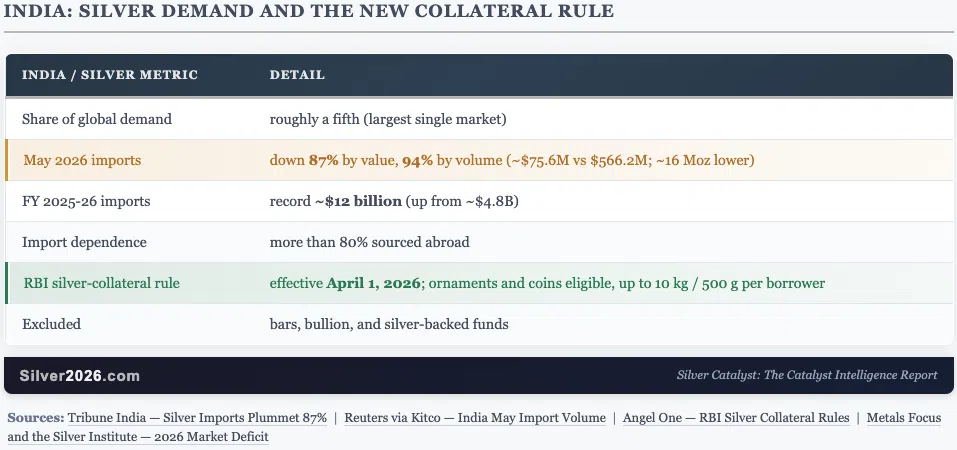
The structural signal is a rule change. Under the Reserve Bank of India's Lending Against Gold and Silver Collateral Directions, effective April 1, 2026, banks and non-bank lenders can for the first time accept silver as loan collateral, up to a per-borrower ceiling of 10 kilograms of silver ornaments and 500 grams of silver coins. Only ornaments and coins qualify; silver bars, bullion, and silver-backed funds are excluded, which keeps the rule aimed at households rather than speculators. Indian households hold vast quantities of silver, much of it sitting idle in rural homes, and the rule lets families borrow against that metal through a regulated bank instead of a pawnbroker.
It is important not to oversell this. This is retail secured lending inside the existing gold-loan system, not a central bank adding silver to its reserves, and the headline ten-to-one weight limit against gold is a ceiling on quantity, not a statement about value. The near-term tonnage effect resists a clean estimate. But the direction matters. Formally recognizing silver as eligible collateral gives the metal a financial role it did not have in the world's largest silver market, and it quietly supports demand by giving households a reason to hold silver rather than sell it, since they can now raise cash against it without letting it go.
Against that structural change sits the noisy headline. India's silver imports did collapse in May, falling 87% by value to about $75.6 million from $566.2 million a year earlier, the lowest in more than three years. Because India buys more than 80% of its silver abroad and prices had roughly doubled over the year, the fall in volume was sharper still, about 94% year over year, a reduction on the order of 16 million ounces for the single month. That looks alarming until you see the cause. In mid-May, New Delhi raised the import duty on silver from 6% to 15% and restricted most silver imports so that only licensed shipments could enter, part of a package to defend a rupee trading at record lows. This is administrative friction on top of a wave of buying that had already been pulled forward, not a collapse in appetite. India spent a record $12 billion on silver imports in the fiscal year that ended in March, up from $4.8 billion the year before, and its demand has been led by investment, with silver ETF inflows at record highs. The May number is a policy distortion working its way through the data, not demand destruction.
Sources: Tribune India — Silver Imports Plummet 87% | Reuters via Kitco — India May Import Volume | Angel One — RBI Silver Collateral Rules | Metals Focus and the Silver Institute — 2026 Market Deficit
What This Means to Silver Investors
The two Indian signals point in opposite directions, and the quieter one matters more. The import collapse is a headline that should fade as rupee pressure eases and the pulled-forward buying washes out; it says nothing about whether Indians want silver. The collateral rule is quiet and structural, and it deepens silver's role in the country that buys more of it than any other.
That matters because the demand side is half of the structural case for silver. Metals Focus and the Silver Institute project a 46.3-million-ounce market deficit for 2026, the sixth consecutive annual shortfall, and a deficit is a story about demand outrunning supply. Anything that makes silver stickier in Indian households, harder to part with because it can now be borrowed against, works in the same direction as that deficit over time, even if the first-year tonnage is small.
For an investor, the signal is to weigh the durable change over the transient one. A one-month import figure distorted by duty hikes and currency defense tells you about New Delhi's foreign-exchange management, not about silver. A structural decision to bring silver into the formal financial system of its largest market tells you something about the metal's standing. The longer-term case for silver rests on that kind of deepening demand set against a supply base that cannot keep pace.
India's evolving relationship with silver is one dimension of the 100-catalyst framework I analyze in Silver Rising, alongside the five other Deep Dives in this issue of the Silver Catalyst newsletter. If you've at least considered investing in silver, I strongly encourage you to sign up, because it takes just $1 to get both. Get full Silver Catalyst Newsletter and Silver Rising book for $1 today.
Thank you.
The Silver Engineer