


Two research desks started talking about a silver surplus this month, but the solar slowdown behind one of those calls is mostly already counted in the shortfall forecast that silver holders rely on.
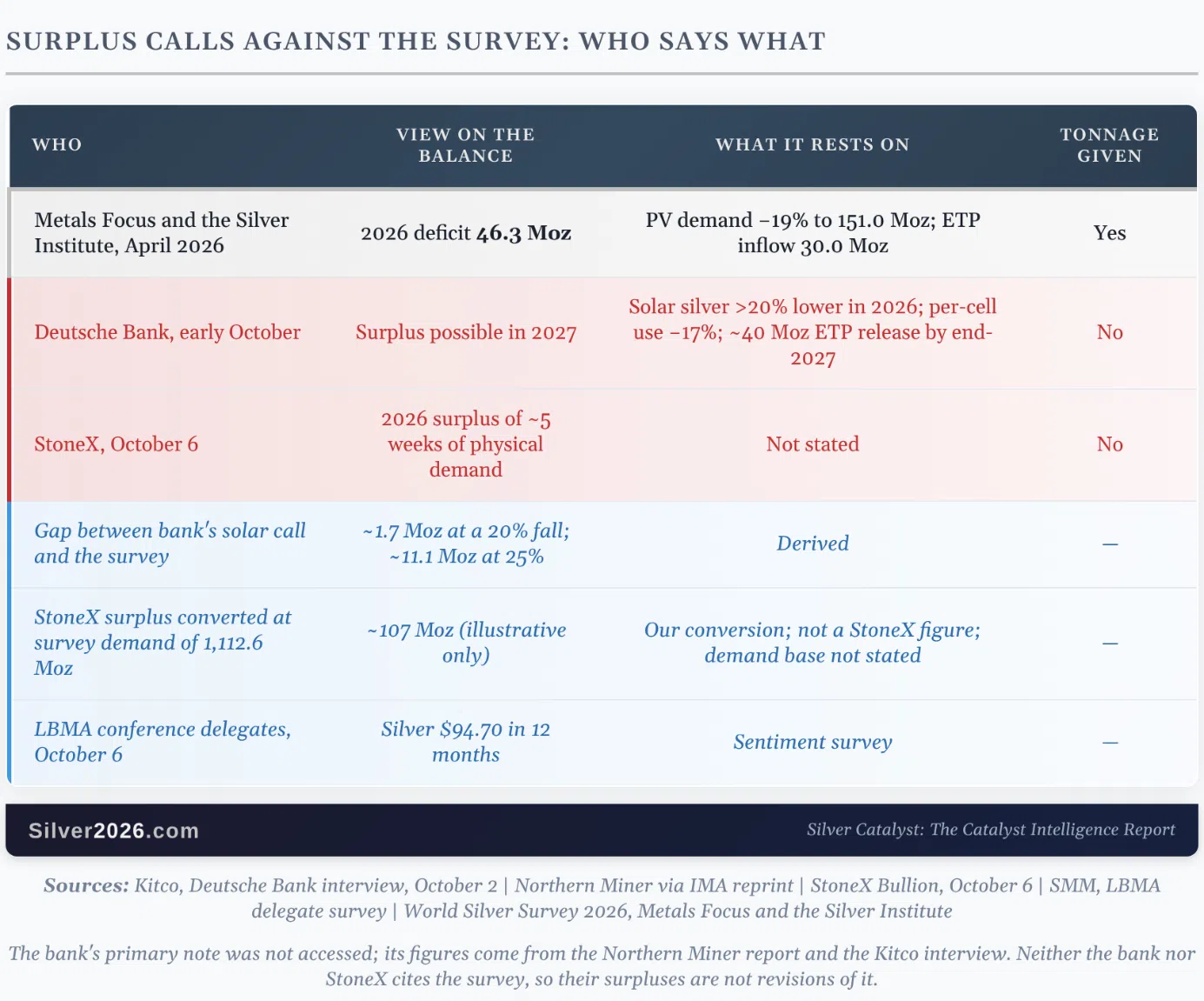
Deutsche Bank and the bullion dealer StoneX both moved from shortfall language to surplus language in early October. Both are forecasts, not measurements of what has happened, and neither firm published how many ounces its surplus comes to. The bank's surplus is for 2027, not this year. On the reported figures, it also appears to count investors selling metal, which the survey's main figure leaves out. The solar decline the bank cites is largely inside the forecast from Metals Focus and the Silver Institute already. So the calls are bad for sentiment over the next six months. On what has been published, though, they do little to the physical balance unless solar demand falls well past 20%. If it does, the bank could prove right. The next test is expected in November, when the survey's authors update their forecast.
Silver has had a weak October. It fell about 6% on October 14 after US consumer prices rose faster than expected, and it steadied over the following days. Kitco's late-afternoon reading on Monday put silver at $56.93 and gold at $4,137.80. That is a gold-silver ratio of about 72.7. At that reading silver was about 20.5% below its 2025 closing price, on MetalCharts' figures. Markets expect the Federal Reserve to hold rates at its October 27 to 28 meeting, and traders see another rise in December as likely. At Golden Meadow® I look at silver through two lenses: interest rates in the short run, and the balance of supply and demand behind the longer-term case.
There are six Deep Dives in this issue of the premium Silver Catalyst newsletter, and in this article, I'll focus on one of them.
Two Desks Turned to Surplus Talk
Deutsche Bank's head of metals research, Daniel Ghali, gave an interview that Kitco reported on October 2. He said Chinese solar silver demand is probably down by a third this year. He added that the market may see a physical surplus in the coming year, meaning more metal coming to market than is used. The bank's research, as reported by Northern Miner, sees a possible surplus as early as 2027. Its reported figures put the global fall in solar silver use above 20% this year. The same report says silver could average $70 an ounce by the second quarter of 2027. That is the bank's view, not a forecast of mine.
StoneX said on October 6 that it expects a 2026 surplus of about five weeks of physical demand. It did not give an ounce figure or say what it counts as physical demand. Measured against the survey's total demand, five weeks would be about 107 million ounces. That is my illustration, not a StoneX figure, and it cannot be compared directly with the survey's balance. It does show that the disagreement is not small.
A surplus is the opposite of the shortfall that silver holders have been relying on. It means mines and recyclers supply more silver in a year than industry, jewellery and coin buyers use, so the extra goes into vaults. Other things being equal, that is bad for the price. When stockpiles are growing, buyers can find metal easily and have no need to pay up to coax it out of holders' hands. A shortfall works the other way. The gap has to be filled from stockpiles, and they shrink over time. A smaller shortfall still draws stockpiles down, only more slowly, while a move into surplus would start refilling them. The balance is not the only thing that moves the price, though. Interest rates and investor buying often matter more in the short run. That is why silver can fall in a shortfall year and rise in a surplus year.
- Most of the Solar Fall Is Already Counted
The solar part of the bank's call is less new than the headlines suggest. Metals Focus and the Silver Institute already forecast photovoltaic demand, the silver used in solar panels, falling 19% this year to 151.0 million ounces. That fall is already inside their 46.3 million ounce shortfall for 2026.
Set against that forecast, the bank's figure adds little. A fall of exactly 20% would take out only about 1.7 million ounces more than the survey assumes. The bank says "more than 20%", though, and gives no single number. Each further five percentage points of decline would remove roughly another 9 million ounces. The bank's one-third figure applies to China, not the world. Commentary that stacks the bank's percentage on top of the survey's forecast counts the same decline twice.
Solar is also not shrinking everywhere. BloombergNEF expects new solar installations outside China to rise about 15% this year, according to pv magazine, while installations in China fall. Each panel now carries less silver than before, so more panels do not mean the same rise in silver use. In September, I looked at why silver holders can lose the solar growth story and keep the shortfall, and that reasoning still applies to the solar part of these calls.
Sources: Kitco, Deutsche Bank interview, October 2 | Northern Miner via IMA reprint | StoneX Bullion, October 6 | SMM, LBMA delegate survey | World Silver Survey 2026, Metals Focus and the Silver Institute
The bank's primary note was not accessed; its figures come from the Northern Miner report and the Kitco interview. Neither the bank nor StoneX cites the survey, so their surpluses are not revisions of it.
Where a Surplus Would Have to Come From
If the solar arithmetic barely moves, the surplus has to come from somewhere else. The bank also points to recovering vault stocks in London, large stocks in New York, rising inventories in Shanghai, and Indian imports running about a quarter below last year. Its fund argument comes with a number. The bank expects funds that hold physical silver to sell about 40 million ounces by the end of 2027, if past rate-rise cycles repeat. That is a scenario about investors changing their minds, not a measurement of mines or factories.
How the survey counts matters here. Its 46.3 million ounce shortfall is the gap between total supply and total demand. Supply comes mainly from mines and recycling, and demand mainly from industry, jewellery, silverware, and coins and bars. Fund buying is counted separately, at 30.0 million ounces. If funds sold metal instead of buying it, the amount that has to come out of stockpiles would shrink sharply. The gap between what is mined and recycled and what is used would not change.
On the reported figures, the bank's surplus appears to count fund buying and selling in its balance, which the survey's main shortfall figure does not. Without the bank's full note, that is my inference. The bank's surplus is also for 2027, while the survey's figure is for 2026, so the two are not yet in direct conflict.
What This Means to Silver Investors
Surplus talk from a large bank can weigh on sentiment, and it may keep doing so for the next six months. That is the honest bearish half. The physical half looks different. The solar weakness the bank cites is mostly already in the forecast that shows a sixth year in a row of shortfall. Much of the rest depends on stockpiles and on investors selling, which changes who holds the metal rather than how much the world mines and uses.
StoneX's call is harder to judge, because it is large and its assumptions are not published. That is a reason for caution, not a reason to treat it as a measurement.
Two things will settle it. Metals Focus and the Silver Institute are expected to publish their interim review in November, with a revised solar line and a revised shortfall. Fund holdings between now and then will show whether investors are selling. Until then, the surplus calls are forecasts rather than measurements, and the survey's forecast of a shortfall still stands.
Surplus forecasts and the solar demand behind them are one dimension of the 100-catalyst framework I analyze in Silver Rising, alongside the five other Deep Dives in this issue of the Silver Catalyst newsletter. If you've at least considered investing in silver, I strongly encourage you to sign up, because it takes just $1 to get both. Get full Silver Catalyst Newsletter and Silver Rising book for $1 today.
Thank you.
The Silver Engineer