


The world's largest primary silver producer reported 11.4% less silver this half-year, and a third of those missing ounces are still being mined by somebody else.
Silver has spent the past few sessions doing something more interesting than the headlines suggest. The metal trades near $62.17 an ounce as I write, up close to 6% in two days, with gold around $4,268 at a seven-week high. The move came from an unexpected direction. Iran and Oman moved toward a proposed framework for shipping through the Strait of Hormuz, oil fell roughly 10% on the week to three-week lows, and with the war premium draining out of energy prices the market cut the odds of a September rate rise to 55% from 67% in two days. Cheaper oil, cooler inflation, lower rates. For a metal that pays no income, that chain matters more than any safe-haven story, though the gold-silver ratio ended the move roughly where it started, so silver has not yet won anything durable here.
Underneath the tape, though, the supply side produced a widely misread number, and unpicking it tells you something durable about how silver actually reaches the market. That work is what I do at Golden Meadow® and in the Silver Catalyst newsletter, and it is why the numbers in a mining company's press release deserve more than a headline read.
There are six Deep Dives in this issue of the premium Silver Catalyst newsletter, and in this article, I'll focus on one of them.
The number everyone quoted, and the number underneath it
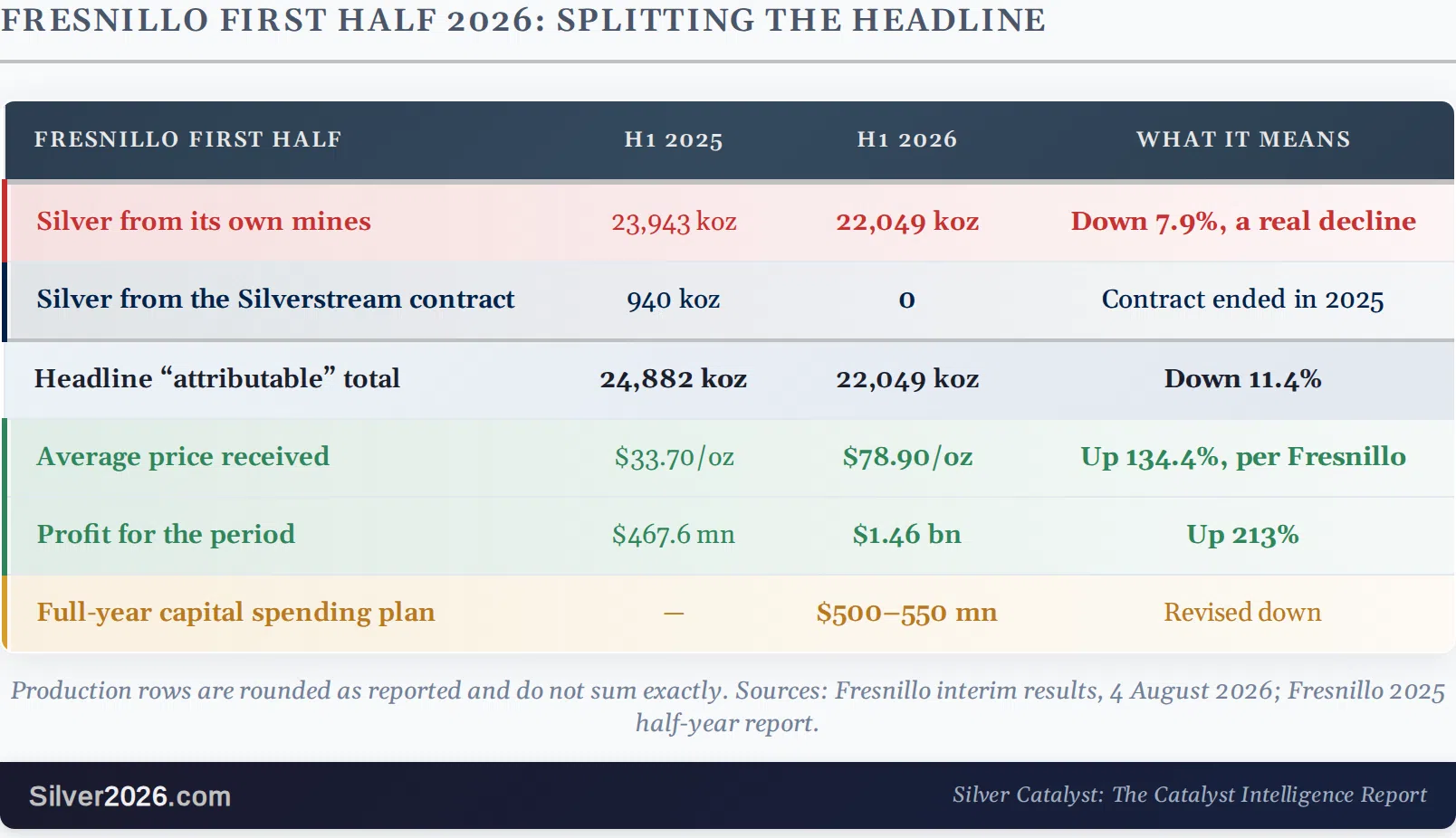
On August 4, Fresnillo published results for the first half of 2026. Attributable silver production came in at 22.0 million ounces against 24.9 million a year earlier, a decline of 11.4%, while revenue rose 74.7% and profit rose 213%. The average price it received for its silver climbed from $33.70 an ounce to $78.90, an increase Fresnillo reports as 134.4%.
The obvious reading writes itself. The biggest primary silver producer on earth could not answer a doubling of the price with ounces, which would be the supply squeeze arriving in a company's own accounts. I drafted the section that way. Then I read the production table.
Fresnillo's own accounts split that decline into two very different parts. Silver from the mines it operates fell from 23,943 thousand ounces to 22,049, a decline of 7.9%. The rest came from something called the Silverstream, which contributed 940 thousand ounces in the first half of 2025 and nothing at all this year. The company puts that cause first, attributing the fall "mainly to the end of the contribution from the Silverstream."
So of the 2,833 thousand ounces that vanished from the headline, roughly a third was a contract ending and two thirds was metal that did not come out of the ground.
What the Silverstream actually was
The Silverstream was a 2007 agreement that paid Fresnillo for silver mined at Sabinas, a mine in Zacatecas that produces silver alongside lead, zinc and copper. Sabinas is wholly owned and operated by Peñoles, a separate company. Fresnillo never dug those ounces. It held a financial claim on them, and its headline production figure adds them to what its own mines produce.
Over the contract's life Peñoles paid Fresnillo $882 million for roughly 52 million ounces. In 2025 it bought the agreement back for $40 million, and Fresnillo booked a $133.0 million paper loss on the exit.
Why it ended is the part that matters for supply. An independent review cut the estimate of what was left in the ground at Sabinas by more than half. Fresnillo's board recorded that the mine's "revenues did not cover its operational costs nor the obligations imposed by the Agreement." The choice put to both companies was a buyback or closing the mine, with 839 jobs attached, and they took the buyback so Peñoles could keep it running. Sabinas produced 2,047 thousand ounces of silver in 2024 and still appears on Peñoles' list of operating mines.
Those ounces did not leave the silver market. They left one company's income statement.
Sources: Investegate: Fresnillo Interim Results, 4 August 2026 | Investegate: Fresnillo 2025 Half-year Report | Peñoles: Sabinas Mining Unit
The lesson hiding in a mine that almost closed
Strip away the accounting and one fact is left standing. A silver mine came close to shutting down while silver was setting records, and the price had nothing to do with saving it. What saved it was removing a financial claim written against its silver. Peñoles gave notice in November 2024, when silver was trading near $30, so the trouble at Sabinas predates the entire rally.
That is not an isolated quirk. Roughly three quarters of the world's silver comes out of mines dug mainly for lead, zinc, copper or gold, with silver arriving as a by-product. Metals Focus and the Silver Institute report that the share of global supply from primary silver mines fell to a new low of 26% last year. Those operations live or die on the economics of everything else in the rock. A high silver price does not keep them open, and it does not make them dig faster.
The two thirds that was a genuine decline deserves its own attention. Grades fell at every operation Fresnillo names, from Ciénega at 117 grams per tonne against 133 a year earlier to Juanicipio at 390 against 423. Grade is simply how much silver sits in each tonne of rock, and when it falls a mine has to process more material for the same output, or accept less output. Fresnillo held its full-year guidance at 42.0 to 46.5 million ounces against 47.6 million produced in 2025.
What This Means to Silver Investors
Three things follow, and they do not all point the same way.
The first is a correction worth making. If you saw the 11.4% figure and read it as 2.8 million ounces disappearing from world supply, the real number is closer to 1.9 million. The rest moved between balance sheets. Company-level production declines and market-level supply losses are not the same thing, and streaming or royalty arrangements are exactly where the two come apart.
The second cuts the other way, and it is the more important of the two. Fresnillo cut its full-year capital spending plan to $500 million to $550 million while its profit tripled. The world's largest primary silver producer, coming off the strongest half-year in its history as a listed company, chose to spend less on finding and building more silver rather than more. If the company best placed to add ounces will not add them at $78 silver, the industry as a whole is unlikely to add them quickly when the market needs them. That is the supply half of the shortage argument stated in a single capital-allocation decision, and the accounting correction does not touch it.
The third is the by-product problem, which is the one most often missed. Because most silver arrives as a by-product, supply can fall for reasons that have nothing to do with silver at all: a shrinking orebody, a weak zinc price, a financing arrangement that stops making sense. Sabinas nearly stopped producing at record silver prices. Anyone expecting the current price to pull new supply into the market quickly is expecting a speed this industry has rarely managed, and the reason is structural rather than temporary.
Set against that, Metals Focus and the Silver Institute forecast a market deficit of 46.3 million ounces for 2026, the sixth consecutive annual shortfall. Deficits are met by drawing down metal already sitting above ground, which works until the owners of that metal decide they would rather keep it. The longer-term case for silver rests on that arithmetic rather than on any single quarter's production headline, and this quarter is a useful reminder to check what a headline is actually counting before trading on it.
Silver's supply story is one dimension of the 100-catalyst framework I analyze in Silver Rising, alongside the five other Deep Dives in this issue of the Silver Catalyst newsletter. If you've at least considered investing in silver, I strongly encourage you to sign up, because it takes just $1 to get both. Get full Silver Catalyst Newsletter and Silver Rising book for $1 today.
Thank you.
The Silver Engineer